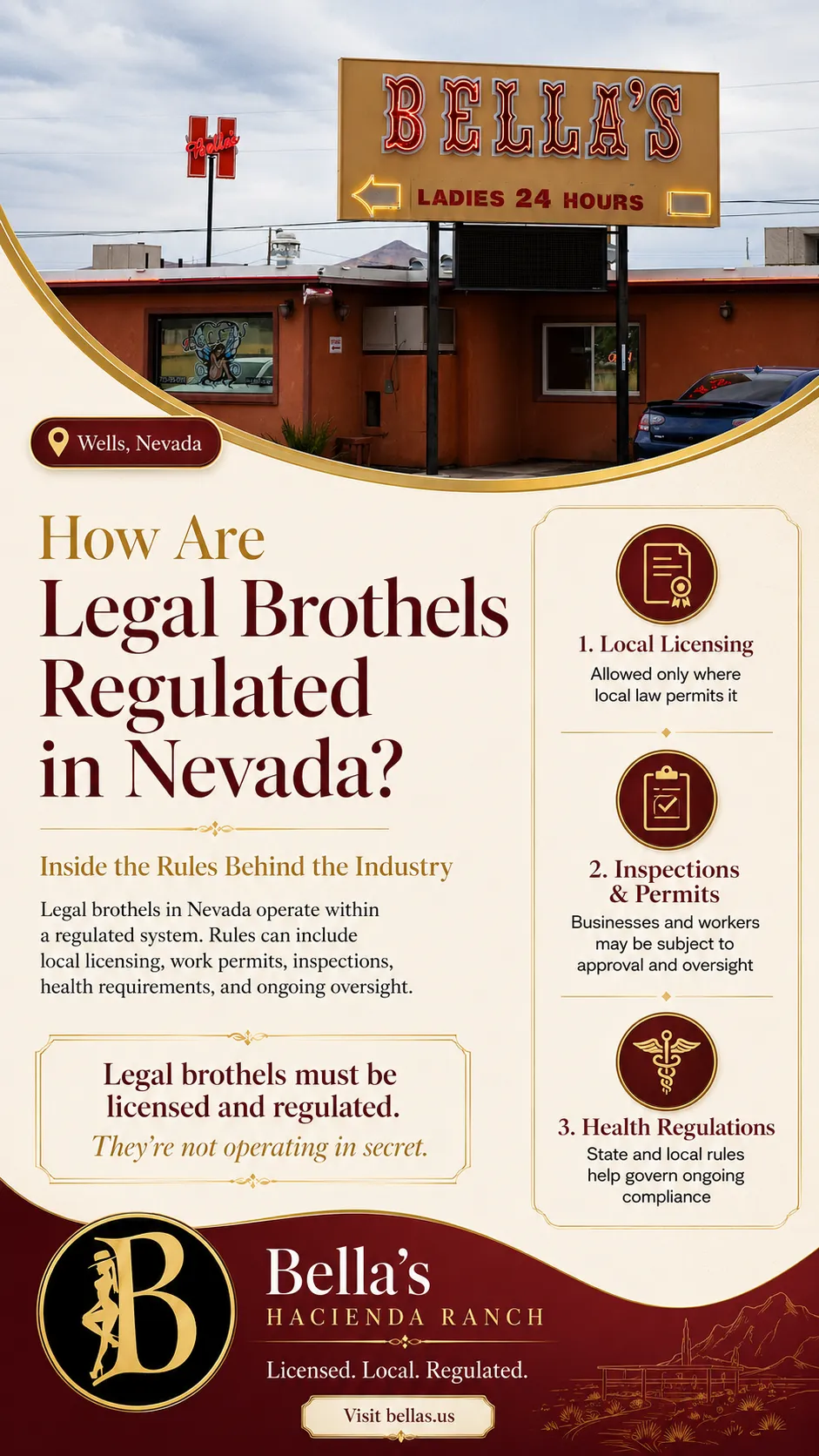
How Are Legal Brothels Regulated in Nevada?
How Are Legal Brothels Regulated in Nevada? Inside the Rules Behind the Industry
Legal brothels are not businesses operating quietly outside the system. In Nevada communities where they are permitted, they exist because a regulatory system allows and oversees them.
That distinction is important.
Legal brothels in Nevada are regulated through a combination of state law, state health regulations, and rules established by the local jurisdiction where the establishment operates. Requirements can include business licensing, employee registration or work permits, inspections, health testing, recordkeeping, and enforcement.
The exact rules can vary by jurisdiction, which is why understanding Nevada's legal brothel industry requires looking beyond the simple question of whether prostitution is legal.
Regulation Starts at the Local Level
Nevada's legal brothel system is unusual because local government plays such a significant role.
A community that is legally eligible to allow brothels does not automatically have them. Local authorities determine whether licensed houses of prostitution may operate and establish rules governing those establishments.
Those rules can address matters such as:
Where a brothel may operate
Who may receive a license
How license applications are reviewed
Employee and worker registration
Work permits
Inspections
Health-related requirements
Operating restrictions
Suspension or revocation of licenses
This means there is no single rulebook that describes every detail of every legal brothel in Nevada.
State law provides part of the framework, while local ordinances determine many of the practical requirements governing individual establishments.
What Regulation Looks Like in Wells, Nevada
Bella’s Hacienda Ranch is located in Wells, Nevada, where the city maintains a dedicated Brothel Code.
The code does considerably more than simply acknowledge that brothels may exist.
It establishes provisions covering license applications, investigations, zoning, license issuance, work permits, inspections, employee registration, health requirements, restrictions, and procedures for suspending or revoking a license.
The city code even defines a brothel as a duly licensed house of prostitution operating in accordance with the chapter's provisions.
In other words, licensing and regulation are not secondary details.
They are central to what legally separates a regulated establishment from unlicensed activity.
Wells also states as public policy that licensed prostitution requires strict regulation of the people, locations, practices, associations, and activities connected with licensed houses of prostitution in order to protect public health, safety, and welfare.
That makes the message especially clear: legality and oversight go together.
Workers and Employees Can Be Subject to Registration Requirements
Regulation does not stop with the business license.
In Wells, the municipal code requires people working as prostitutes or bartender/managers, along with certain people working or residing on the premises, to hold valid work permits. Employees covered by the ordinance must also be registered with the city's police authority.
The registration process includes identifying information and other information required under the local ordinance. The city also provides for investigation of information supplied by applicants.
These requirements help illustrate an important difference between a licensed brothel and prostitution occurring outside Nevada's regulated system.
A legal establishment operates within a structure where the business and applicable workers are subject to identifiable rules and governmental oversight.
Legal Brothels May Be Inspected
The idea that legal brothels operate completely behind closed doors can also create the wrong impression.
Privacy for guests is one matter. Regulatory secrecy is another.
Under the Wells Brothel Code, the city's authorized representatives may enter licensed brothel premises during business hours for purposes that include examining the premises or employment records and determining whether the establishment is complying with local rules and state law.
The code also requires cooperation with Nevada health authorities during certain communicable-disease investigations and prevention efforts.
That oversight is part of what regulation means in practice.
A guest may reasonably value discretion and personal privacy while the establishment itself remains accountable to regulatory authorities.
Those two ideas are not contradictory.
Nevada Also Has State Health Requirements
Some oversight comes from state regulation rather than solely from local government.
Nevada Administrative Code provisions specifically address sex workers employed by or contracted to work in licensed houses of prostitution.
Current state regulations require specified testing before a person may begin employment as a sex worker in a licensed house of prostitution. They also establish continuing testing requirements and require a worker to cease employment if certain required tests show the presence of specified infections.
The regulations also require licensed houses of prostitution to display a health notice supplied by the state and contain requirements concerning reporting and cooperation when communicable disease is known or suspected.
Wells adds its own local health provisions. Its municipal code requires medical examinations for prostitutes working at licensed operations and connects those requirements with Nevada's state health regulations.
This is another reason the phrase “regulated adult industry” matters.
There are formal rules that continue after a license has been issued.
Licensing Is Not a Permanent Permission to Ignore the Rules
Obtaining approval does not mean an establishment is free from future oversight.
Wells' Brothel Code includes provisions specifically addressing the revocation or suspension of licenses. Its overall regulatory structure allows local authorities to enforce compliance rather than treating licensing as a one-time administrative formality.
The city's stated policy is also explicit that a brothel license is considered a privilege rather than an automatic right.
That principle is useful for understanding the industry more broadly.
Being licensed means agreeing to operate within rules that continue to apply.
That may include regulatory scrutiny of the establishment, its workers, records, health requirements, and operating practices depending on the jurisdiction.
Regulation and Discretion Are Different Things
For a first-time visitor, words such as privacy and discretion can occasionally sound as though everything surrounding a brothel must be secret.
That is not what discretion means in a licensed environment.
A business can respect the privacy of an adult guest while still operating openly within the regulatory system that governs it.
At Bella’s Hacienda Ranch in Wells, Nevada, that distinction fits naturally with a broader philosophy of treating adults with dignity and respect.
Privacy is personal.
Licensing is regulatory.
And a legitimate legal framework does not require the establishment itself to disappear into the shadows.
For someone researching Nevada's adult industry, this is a useful standard to keep in mind: look for lawful, licensed establishments operating within jurisdictions that recognize and regulate them rather than assuming that any adult-oriented business in Nevada is part of the legal brothel system.
Final Thoughts
So, how are Nevada brothels regulated?
There is no single statewide licensing system governing every detail. Instead, Nevada combines state law and health regulations with substantial local oversight in jurisdictions where brothels are permitted.
In Wells, that oversight includes a detailed municipal Brothel Code covering licensing, work permits, employee registration, inspections, health requirements, operational rules, and enforcement.
That structure is an important part of understanding what the word legal actually means.
A licensed brothel is not legal because nobody is watching.
It is legal because it operates within a system that establishes where it may operate, who may work there, what requirements must be followed, and how those requirements can be enforced.
For visitors who value discretion, clarity, and informed personal choices, understanding that distinction can make Nevada's legal brothel system far less mysterious.
Explore The Hacienda Journal for more straightforward guides to Nevada brothel laws, Wells, first-time visitor questions, privacy, and the state's distinctive licensed adult industry.
This article is for general informational purposes and does not constitute legal advice. Nevada laws, administrative regulations, and local ordinances may change. Current requirements should always be verified with the appropriate state or local authority before publication or reliance.
