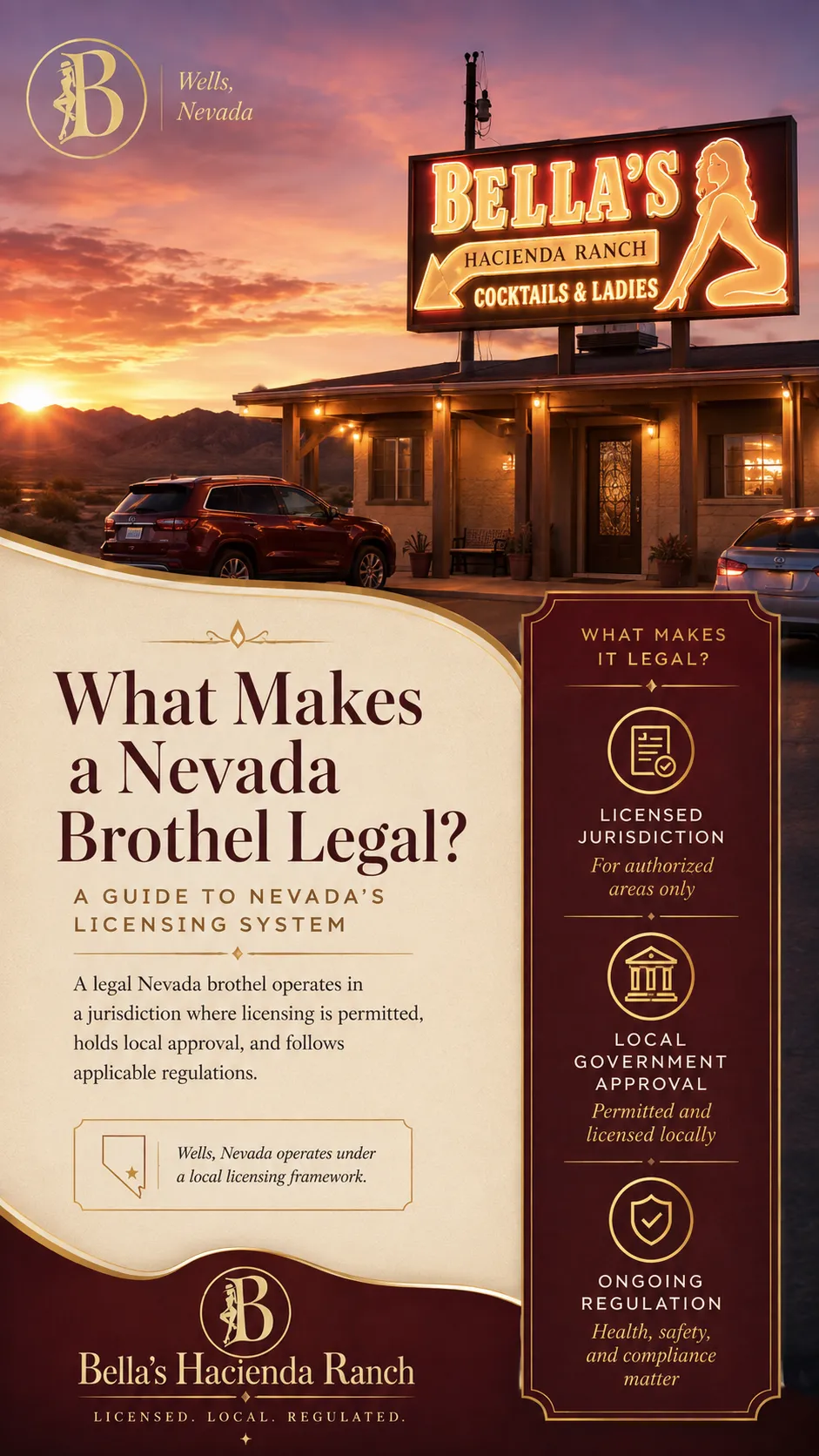
What Makes a Nevada Brothel Legal? | Bella’s Hacienda Ranch
What Makes a Nevada Brothel Legal? A Guide to Nevada’s Licensing System
Nevada is famous for doing things differently, but few subjects are surrounded by as much misunderstanding as its legal brothel system.
So, what makes a Nevada brothel legal?
The short answer is that a brothel must operate in a Nevada jurisdiction where licensed prostitution is permitted, hold the licenses required by that local government, operate within an approved licensed location, and follow the applicable state and local regulations governing the establishment and its workers.
That distinction matters because prostitution is not simply legal everywhere in Nevada.
Nevada law specifically makes prostitution outside a licensed house of prostitution unlawful for both workers and customers. Whether a licensed brothel may operate also depends heavily on local law.
Understanding that framework helps separate Nevada's regulated brothel system from the myths that often surround it.
Nevada Does Not Simply Legalize Prostitution Everywhere
One of the most common misconceptions is that prostitution is legal throughout Nevada.
It is not.
Nevada Revised Statutes make an important distinction between activity occurring within a licensed house of prostitution and activity occurring outside that regulated system.
Under NRS 201.353, a person working as a prostitute may not legally engage in prostitution or solicitation outside a licensed house of prostitution. NRS 201.354 establishes a corresponding restriction for customers.
That means simply being somewhere in Nevada does not make an establishment—or an arrangement—legal.
Location and licensing matter.
This is the foundation of Nevada's unusual system: the state establishes legal boundaries, while eligible local governments determine whether licensed brothels will be permitted and how they will be regulated.
Local Licensing Is What Makes the Difference
For a Nevada brothel to operate legally, being located in the right county or city is only the beginning.
The appropriate local government must also permit and license the establishment.
Nevada law gives local licensing authorities considerable power to grant or deny licenses, establish conditions and restrictions, regulate licensees, and suspend or revoke licenses when necessary. At the same time, NRS 244.345 prohibits brothel licensing in counties with populations of 700,000 or more.
That population restriction is one reason Nevada's best-known tourist destination is often misunderstood.
Are brothels legal in Las Vegas?
No.
Las Vegas is located in Clark County. The U.S. Census Bureau estimates Clark County's 2025 population at more than 2.4 million—well above Nevada's 700,000-person statutory threshold for prohibiting the licensing of houses of prostitution.
So although Nevada is associated internationally with legal brothels, licensed brothels are not legal in Las Vegas or elsewhere in Clark County.
Legal establishments operate only in jurisdictions where state law allows local licensing and the local government has chosen to permit it.
What Makes a Brothel Legal in Wells, Nevada?
This is where Bella’s Hacienda Ranch's location becomes particularly relevant.
Bella’s Hacienda Ranch is located in Wells, Nevada, and Wells maintains a dedicated section of its municipal code specifically governing brothels.
The Wells Brothel Code establishes a local licensing and regulatory system covering areas including license applications, investigations, zoning, license issuance, work permits, inspections, health requirements, employee registration, and license suspension or revocation.
The Wells Board of Councilmen acts as the city's prostitution licensing and control board. Among its responsibilities are reviewing applications, investigating applicants, granting or refusing licenses, receiving complaints, and placing restrictions or conditions on licenses when appropriate.
This helps explain an important part of the phrase “legal Nevada brothel.”
Legal does not simply describe the activity. It describes an establishment operating within an established regulatory framework.
Licensing Extends Beyond the Building
A licensed establishment is only one part of the regulatory structure.
In Wells, local rules also address the people working within licensed brothels.
The Wells Brothel Code requires valid work permits for people working as prostitutes or bartender/managers, as well as certain people residing or working on the premises. Employees must also be registered according to the city's requirements.
The city's licensing process also provides for investigation of applicants, while local authorities have powers to inspect licensed premises and review compliance with city and state requirements.
These rules illustrate why Nevada's licensed brothel industry is very different from unlicensed prostitution.
A legal establishment operates within a system of identifiable businesses, approved premises, regulatory oversight, licensing, and enforceable rules.
Health Regulation Is Also Part of the System
Public health requirements are another important component of the legal framework.
Wells' current brothel code requires medical examinations for licensed workers and incorporates testing requirements connected with Nevada health regulations. The code also establishes procedures for work clearance and what happens when applicable health requirements are not satisfied.
The city may also suspend or revoke a license for violations of its brothel code, applicable state law, or certain health requirements.
These regulations are one reason it is misleading to describe Nevada's system simply as “legal prostitution.”
A more accurate description is licensed and locally regulated prostitution within specific jurisdictions.
Legal Does Not Mean Unregulated
The word “legal” can sometimes suggest an absence of restrictions.
In Nevada's brothel system, the opposite is closer to the truth.
Legality depends on boundaries: where an establishment operates, whether the jurisdiction permits it, whether the business has the required license, whether applicable workers are properly registered or permitted, and whether the establishment continues to comply with local and state rules.
For visitors, that distinction provides something valuable beyond legal terminology: clarity.
A regulated environment establishes expectations and responsibilities. It separates licensed adult businesses operating within Nevada's legal framework from unlicensed activity outside it.
For Bella’s Hacienda Ranch in Wells, that setting also supports something central to the Bella's philosophy—an atmosphere where privacy, discretion, dignity, personal choice, and respectful human connection can exist within clearly defined boundaries.
Final Thoughts
So, what makes a Nevada brothel legal?
It is not simply the fact that it is located in Nevada.
A legal Nevada brothel operates in a jurisdiction where licensing is permitted, receives authorization from the appropriate local government, operates within its approved premises, and follows applicable licensing, worker-registration, health, inspection, and other regulatory requirements.
Wells, Nevada maintains its own detailed brothel code and local licensing system, making it a very different legal environment from places such as Las Vegas, where brothel licensing is prohibited.
For anyone curious about Nevada's legal adult industry, understanding that distinction is the best place to begin.
Bella’s Hacienda Ranch believes informed visitors are more comfortable visitors. Explore more of The Hacienda Journal to learn about Nevada's legal brothel system, Wells, privacy, etiquette, and what first-time visitors may want to know.
This article is provided for general informational purposes and is not legal advice. Nevada statutes and local ordinances may change, so current regulations should always be verified with the appropriate government authority.
