Legal vs. Illegal Brothels in Nevada: Know the Difference
Legal vs. Illegal Brothels in Nevada: How to Know the Difference
Privacy and transparency may sound like opposites, but in Nevada's licensed brothel industry, they serve very different purposes.
A visitor may reasonably expect discretion around a personal experience. The business itself, however, should exist within an established legal and regulatory framework.
So what separates a legal Nevada brothel from illegal prostitution?
A legal Nevada brothel is a licensed house of prostitution operating in a jurisdiction where that activity is permitted and subject to applicable local and state rules. A business or individual offering prostitution outside that licensed framework is not made legal simply because it is located in Nevada.
Nevada law specifically states that it is unlawful for a customer to engage in prostitution or solicitation for prostitution except in a licensed house of prostitution.
That makes licensing, location, and regulatory oversight essential distinctions for anyone researching Nevada's adult industry.
Legal vs. Illegal Brothels in Nevada Starts With Licensing
The most important word is licensed.
Nevada does not simply allow prostitution everywhere within the state. Instead, state law permits a system in which houses of prostitution may operate only where legally allowed and properly licensed.
Nevada law also prevents counties with populations of 700,000 or more from issuing licenses for businesses employing people for prostitution. Smaller jurisdictions may have authority to regulate licensed establishments, but they are not required to permit them.
This creates a system where legality depends heavily on jurisdiction.
A legal brothel therefore has more behind it than a business name, website, advertisement, or physical address.
There should be a lawful local framework supporting its operation.
Being an Adult Business Does Not Make a Business a Legal Brothel
This is one of the most useful distinctions for first-time visitors.
Nevada has many businesses associated with adult entertainment, but adult entertainment and licensed prostitution are not legally interchangeable.
Escort agencies, entertainment businesses, adult-oriented venues, and licensed houses of prostitution can fall under different legal categories.
For example, the City of Wells separately regulates escort agencies and specifically prohibits an escort from committing an act of prostitution while acting as an escort.
That distinction matters because a traveler should never assume that an adult-oriented service is legally allowed to provide prostitution merely because it advertises in Nevada.
Likewise, phrases such as “private,” “discreet,” or “adult entertainment” do not establish legal brothel status.
Licensing does.
What Transparency Looks Like at a Licensed Brothel
Transparency does not mean exposing a guest's private choices.
It means the establishment itself operates within recognizable rules.
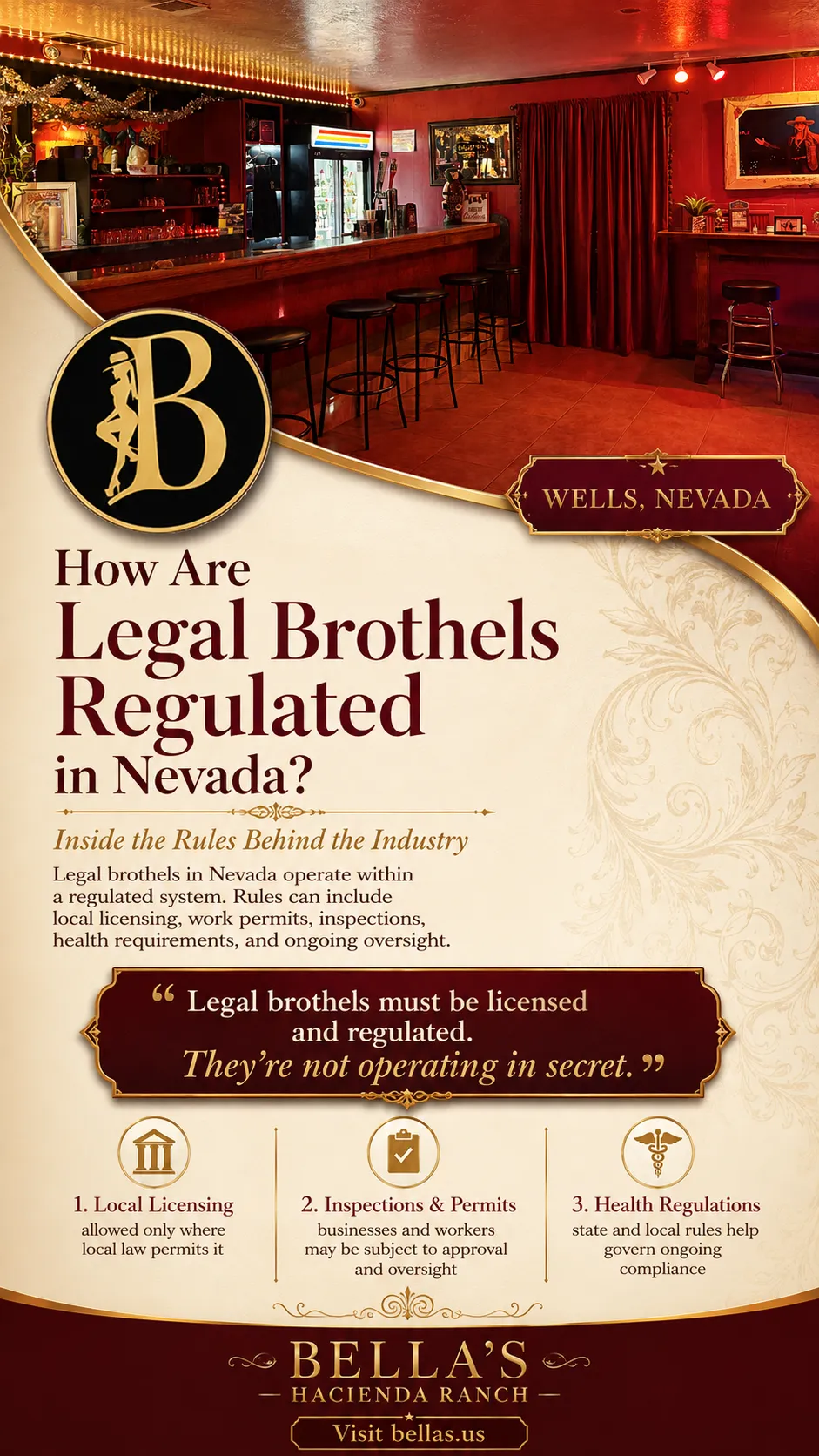
In Wells, Nevada, the municipal code defines a brothel as a duly licensed house of prostitution operating in accordance with the city's Brothel Code.
That code includes provisions dealing with:
Licensing
Location and zoning
Work permits
Employee registration
Inspections
Medical requirements
Operational restrictions
License suspension or revocation
The city expressly states that public confidence in licensed prostitution depends on strict regulation of the people, locations, practices, and activities connected with licensed houses of prostitution.
That is a useful way to understand transparency in this context.
The personal details of a guest may remain private, while the legal standing of the establishment itself should not depend upon secrecy.
Oversight Is One Sign of a Regulated Establishment
Licensed establishments can also be subject to government inspection.
Under the Wells Brothel Code, authorized city representatives may enter licensed brothel premises during business hours to examine the premises or certain employment records and determine whether the business is complying with local regulations and state law.
Applicable workers are also subject to work-permit and registration requirements in Wells. The municipal code requires valid work permits for prostitutes and bartender/managers, along with registration requirements for other employees covered by the ordinance.
These requirements demonstrate an important point:
Legal brothels do not become legitimate by remaining invisible to authorities. They operate within a system that recognizes, licenses, and oversees them.
That is very different from an unlicensed arrangement attempting to operate outside the established system.
How Can a Visitor Check Whether a Nevada Brothel Is Legal?
For a first-time visitor, a little research can provide valuable clarity.
Rather than relying solely on advertising, consider several basic questions:
Where is the establishment located?
Licensed brothels are not permitted everywhere in Nevada.Does that jurisdiction legally permit licensed houses of prostitution?
Local law matters considerably.Is the establishment operating as a licensed brothel?
An adult business, escort service, or private arrangement should not automatically be treated as one.Does the local government have regulations governing brothels?
Municipal or county codes can provide useful context.Does the establishment openly identify its location and lawful status?
Legitimate regulation and discretion toward guests can coexist.
When legal status is uncertain, information from the relevant city, county, or Nevada government source is more reliable than assumptions based on advertising.
Why the Difference Matters to Visitors
Understanding legal versus illegal activity is not merely a technical concern.
For many first-time visitors, uncertainty is one of the biggest barriers to feeling comfortable.
Knowing that an establishment operates within a recognized regulatory system can make the environment easier to understand before any personal decision is made.
That is particularly relevant to the values surrounding Bella’s Hacienda Ranch in Wells, Nevada.
Privacy should allow an adult to make personal decisions without unnecessary judgment. It should not require uncertainty about whether the establishment itself operates within the law.
Discretion protects the individual.
Transparency creates clarity around the business.
Those ideas can exist together.
Bella’s Hacienda Ranch and the Wells Regulatory Framework
Bella’s Hacienda Ranch is located in Wells, Nevada, where the city maintains a detailed municipal Brothel Code.
The code addresses the establishment itself as well as work permits, employee registration, inspections, health-related requirements, and enforcement provisions.
This local context is important because Nevada's brothel laws cannot be accurately understood by looking only at the state as a whole.
Different communities have different legal frameworks.
For visitors researching Bella’s or another Nevada establishment, location should always be part of understanding its legal status.
Final Thoughts
The difference between legal and illegal brothels in Nevada comes down to much more than whether an establishment happens to be inside Nevada.
A lawful brothel operates as a licensed house of prostitution in a jurisdiction where such establishments are legally permitted and subject to applicable regulations.
Unlicensed prostitution falls outside that framework.
For visitors, one simple principle is worth remembering:
Discretion does not require regulatory secrecy.
A sophisticated, private experience can still exist within clearly defined rules, licensing, and oversight.
Understanding that distinction allows adults to make more informed choices with greater confidence, dignity, and peace of mind.
To learn more about Nevada's licensed brothel system, Wells, and questions first-time visitors often have, continue exploring The Hacienda Journal at Bella’s Hacienda Ranch.
This article is for general informational purposes only and does not constitute legal advice. Nevada statutes and local ordinances may change, so current requirements should be confirmed with the appropriate government authority.
