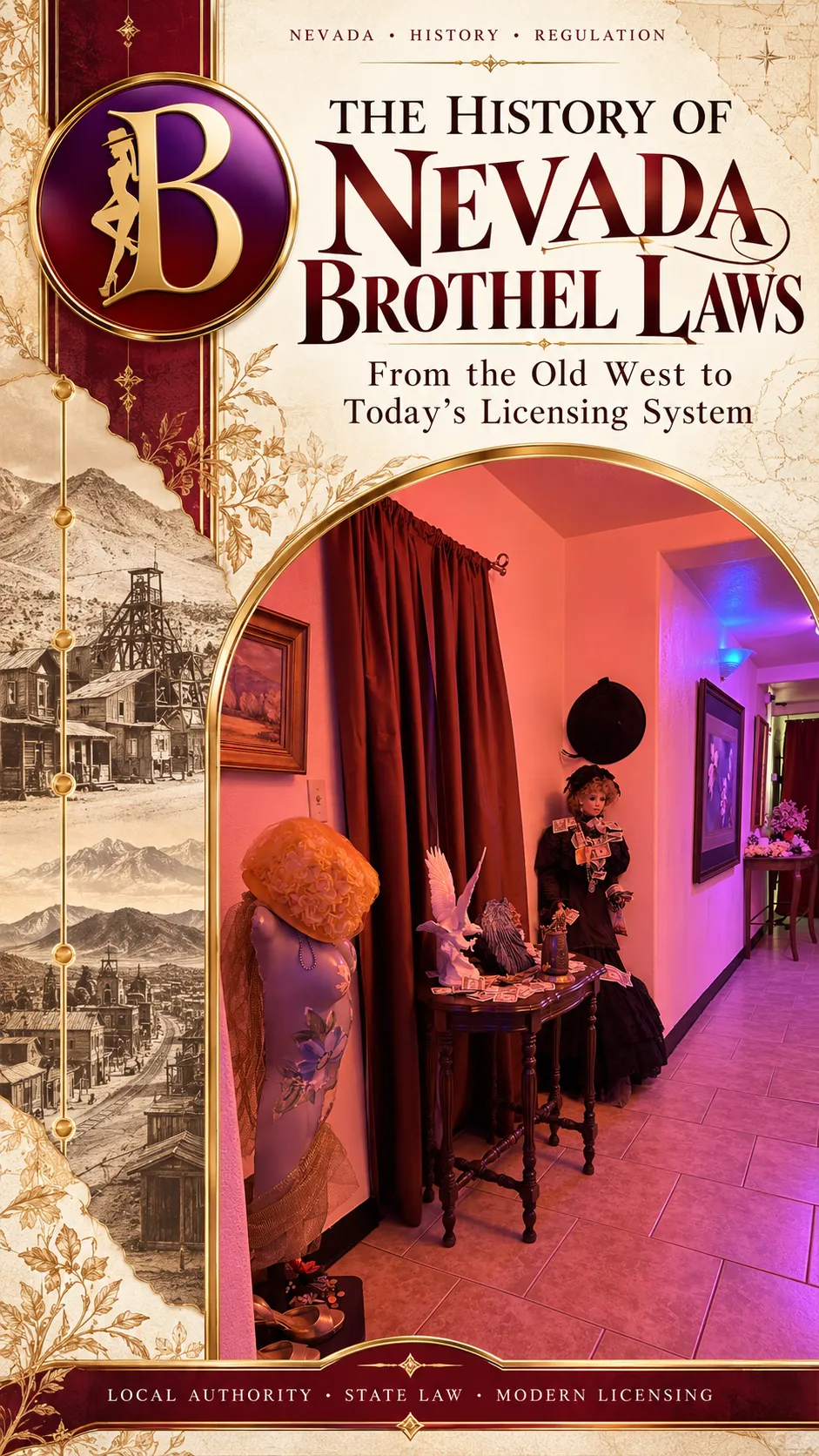
History of Nevada Brothel Laws: From the Old West to Today
History of Nevada Brothel Laws: From the Old West to Today's Licensing System
Old West imagery often makes Nevada's brothel history seem like a simple story: prostitution was legal in Nevada, and the tradition continued unchanged. The real history is more complicated.
The history of Nevada brothel laws reflects changes in mining communities, local government authority, public policy, and state legislation. Today's system did not emerge from one law that made prostitution legal everywhere. Instead, it developed over time, with local governments playing an important role in deciding where licensed establishments could operate. Historical research from the University of Nevada, Las Vegas, examines how state statutes and local rules shaped the modern industry.
Understanding that history helps explain why legal brothels exist in some parts of Nevada but not in others, and why the state's approach differs from the popular image many people associate with the Wild West.
How Mining Towns Shaped Nevada's Early History
During the nineteenth century, Nevada's mining communities attracted workers, merchants, travelers, and entrepreneurs. As settlements grew around mining activity, prostitution became part of the wider social and commercial environment found in many frontier towns.
The discovery of the Comstock Lode near Virginia City in 1859 helped drive a major mining boom. Businesses developed to serve the growing population, and prostitution became part of the economic and social history of mining communities. Similar patterns appeared in other Western towns, although local responses varied.
At that time, Nevada did not operate under the same statewide licensing framework that governs licensed brothels today.
Instead, local tolerance, municipal rules, public attitudes, and enforcement practices influenced how prostitution was handled. Some towns maintained designated red-light districts, while authorities in other communities took different approaches.
This history is important because it shows that Nevada's modern system developed gradually. It was not simply a continuation of an uninterrupted legal tradition.
Why Local Government Became So Important
One of the most distinctive features of Nevada's approach is the role of local government.
Historical accounts describe how disagreements over prostitution frequently involved county commissioners, city authorities, and courts. Local officials had to address questions about where brothels could operate, how businesses should be regulated, and whether particular communities would permit them at all.
Court decisions helped clarify the extent of local authority.
In Kuban v. McGimsey (1980), the Nevada Supreme Court considered a county's authority to prohibit brothels. The decision discussed the statutory licensing framework and concluded that state law did not require every county to permit brothels. Local communities retained authority to prohibit them under the legal framework addressed by the case.
The practical consequence is significant: a brothel's legality depends on more than its being located within Nevada.
The relevant jurisdiction, licensing authorization, and applicable rules all matter.
How Nevada Developed Its Modern Licensing Framework
Nevada's modern system developed through a combination of legislation, court decisions, and local regulation rather than a single statewide legalization event.
Researchers at the University of Nevada, Las Vegas describe the state's system as one in which local municipalities and counties have played important roles in regulating the legal brothel market. Their research examines licensing, business organization, regulatory practices, and the broader history of the industry.
Current Nevada statutes reflect this layered framework.
Under NRS 201.353 and NRS 201.354, prostitution and solicitation outside a licensed house of prostitution are unlawful under the circumstances specified by the statutes. These provisions are important because they distinguish licensed establishments from activity outside the legal framework.
Meanwhile, NRS 244.345 addresses county licensing authority and restrictions on licensing houses of prostitution. It prohibits licensing boards in counties with populations of 700,000 or more from granting licenses for these businesses. Local restrictions may also apply elsewhere.
For that reason, it is inaccurate to describe Nevada as a state where prostitution is legal everywhere. The law is jurisdiction-specific, and individual establishments must comply with the applicable requirements.
Why Las Vegas and Rural Nevada Have Different Histories
Las Vegas is often the first place people associate with Nevada's adult entertainment industry. However, its history is not the same as the history of licensed brothels in rural Nevada.
Historical research on prostitution in Las Vegas documents how local decisions, federal enforcement, public attitudes, and changes in the city's identity influenced the closure of brothels there. By the postwar period, Las Vegas was developing as a major resort destination, and its approach to prostitution diverged from that of certain rural communities.
Today, the distinction remains important.
The presence of casinos, nightlife, and adult entertainment in a city does not mean that licensed brothels are legally permitted there. State statutes and applicable local laws determine where licensed prostitution may operate.
This is one of the reasons visitors should check the rules for a specific destination rather than relying on Nevada's broader reputation.
What This History Means for Wells, Nevada
Wells offers a different setting from the state's major urban destinations.
Located in northeastern Nevada, Wells is a small community in Elko County at the junction of Interstate 80 and U.S. Highway 93. The town's history is closely connected to Indigenous history, the California Trail, and the development of the Transcontinental Railroad.
Bella's Hacienda Ranch is located in Wells. For readers researching the ranch, understanding the wider legal and historical context provides useful background about the region and Nevada's distinctive regulatory framework.
The important distinction is between the state's general legal structure and an individual business's current status and policies. A location alone does not establish licensing authorization, and older historical accounts should not be treated as proof of present-day compliance.
Visitors with questions about a specific establishment should consult current official information and contact the business directly about its visitor procedures.
Separating Old West Stories From Modern Regulation
Popular culture often portrays the Old West through saloons, mining towns, colorful personalities, and dramatic stories. Those images can be memorable, but they do not tell the full story of Nevada's brothel industry.
The modern system involves statutes, local licensing decisions, operating requirements, and ongoing public debate. Academic research has examined not only its legal history but also its economic, social, and organizational dimensions.
A more accurate understanding separates three things:
Historical practice: how prostitution was tolerated, restricted, or managed in different communities over time.
Legal framework: the statutes and court decisions that shaped today's system.
Current authorization: whether a particular establishment is permitted to operate under the rules that apply to its location.
Keeping these distinctions clear makes it easier to understand both Nevada's past and its current laws.
Final Thoughts
The history of Nevada brothel laws is a story of changing public attitudes, local authority, court decisions, and state regulation. From nineteenth-century mining communities to today's licensing framework, the legal landscape has evolved over generations rather than through one simple act of legalization.
That history explains why licensed brothels may operate in certain Nevada jurisdictions while remaining prohibited in others.
For readers interested in Bella's Hacienda Ranch, learning about Wells and the state's legal framework provides a more complete perspective than relying on Old West stereotypes alone.
Explore the history, learn about the region, and consult current official sources whenever you need to understand a legal requirement.
This article is for general educational purposes and is not legal advice. Nevada statutes and local ordinances may change. Consult current official sources for questions involving specific licensing or legal requirements.
